
An open construction ERP for construction firms and design offices.
The leading proprietary platforms in the European construction software market are functionally strong. The price is high licence cost and permanent lock-in to a single vendor. OpenConstructionERP is a working demonstration that an alternative base architecture is possible without giving up construction-domain depth.
The platform has been built since 2024 in response to a specific observation: mid-size construction firms can run an estimating, BIM take-off, procurement and site-billing stack without renting it from a single vendor in perpetuity. The result is a modular construction ERP that covers the full life cycle of a project - from the first estimate to the final invoice - on the customer's own infrastructure, with all source code public on GitHub under AGPL-3.0.
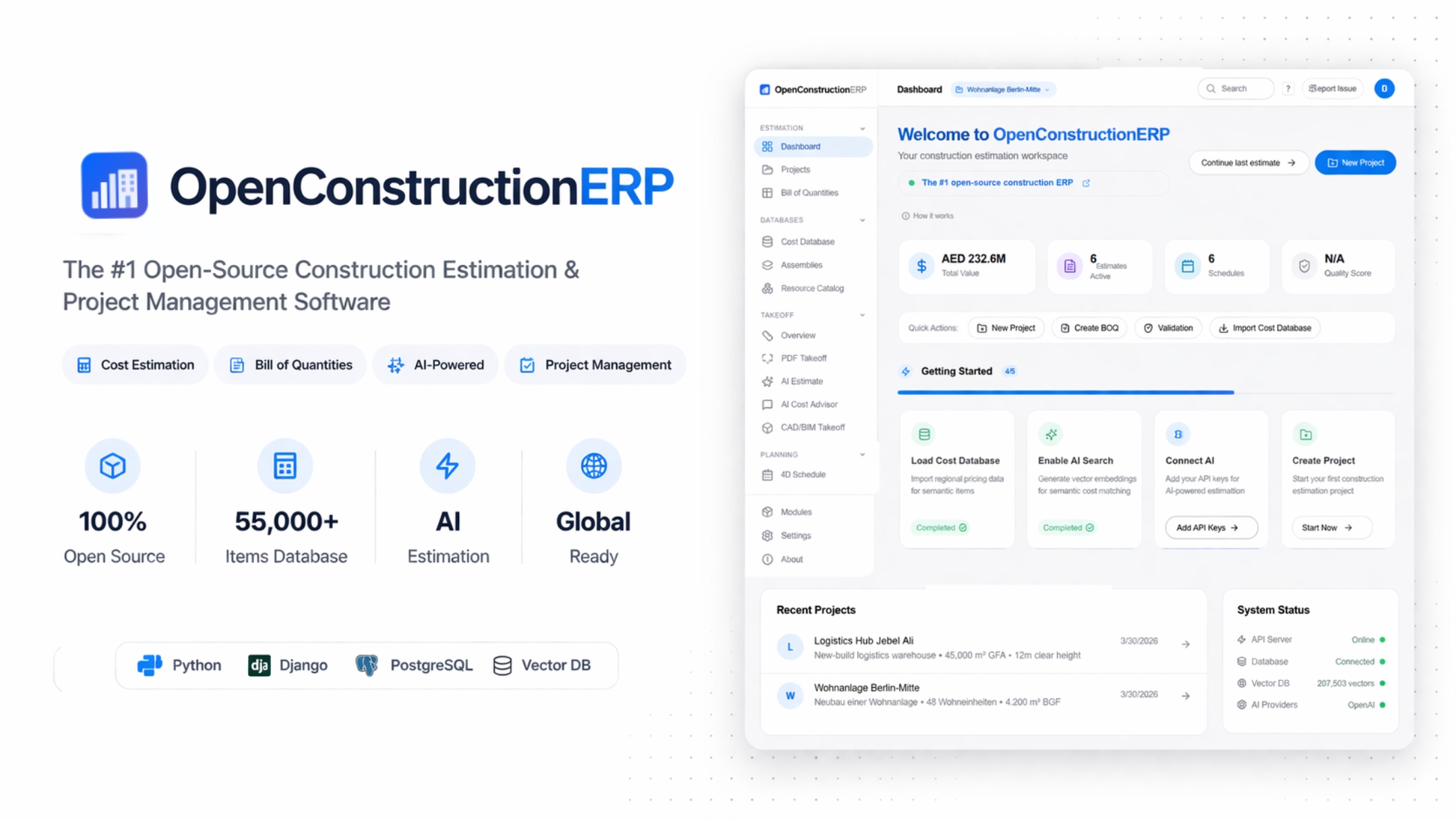
It is in production as of v5.2.8, with a live demo at openconstructionerp.com/demo and one-command local install. At the time of this paper it comprises 116 modules (frontend, backend and plugins combined) and is backed by a cost database with 55,000 items across eleven regions. The rest of this article walks through what that means in practice - what ships, how a real project flows through the platform, what it replaces and what it doesn't, the architecture, the five-year cost picture, and who already works with our open tools.
A 12-minute tour of the platform
Before reading the spec sheet - see the system in motion. The walkthrough covers a real project from BIM import to BoQ to procurement, in twelve minutes.
What ships today
- 116 modules in v5.2.0 (frontend, backend, plugins) across estimating, BIM take-off, 4D/5D, procurement and site billing - 33 core modules plus over 80 specialised and regional modules.
- 55,000+ items in the CWICR cost database across 11 regional price baselines (DACH, UK, US, France, Russia, LATAM and more), with 7,000+ resources (materials, labour, equipment).
- 57 validation rules across 16 rule sets - DIN 276, GAEB, NRM, MasterFormat, ÖNORM, SIA, GB/T 50500, BC3 / FIEBDC-3 and other regional standards.
- GAEB DA XML (X83 / X84 / X89), IFC 4, IDS, BCF, OpenCDE; native connectors for the common BIM/CAD file formats:
.rvt,.ifc,.dwg,.dgn. - 27 UI languages; runs from a 2 GB VPS (~€10/month); 17 modules active by default per user role; custom modules via the documented plugin architecture.
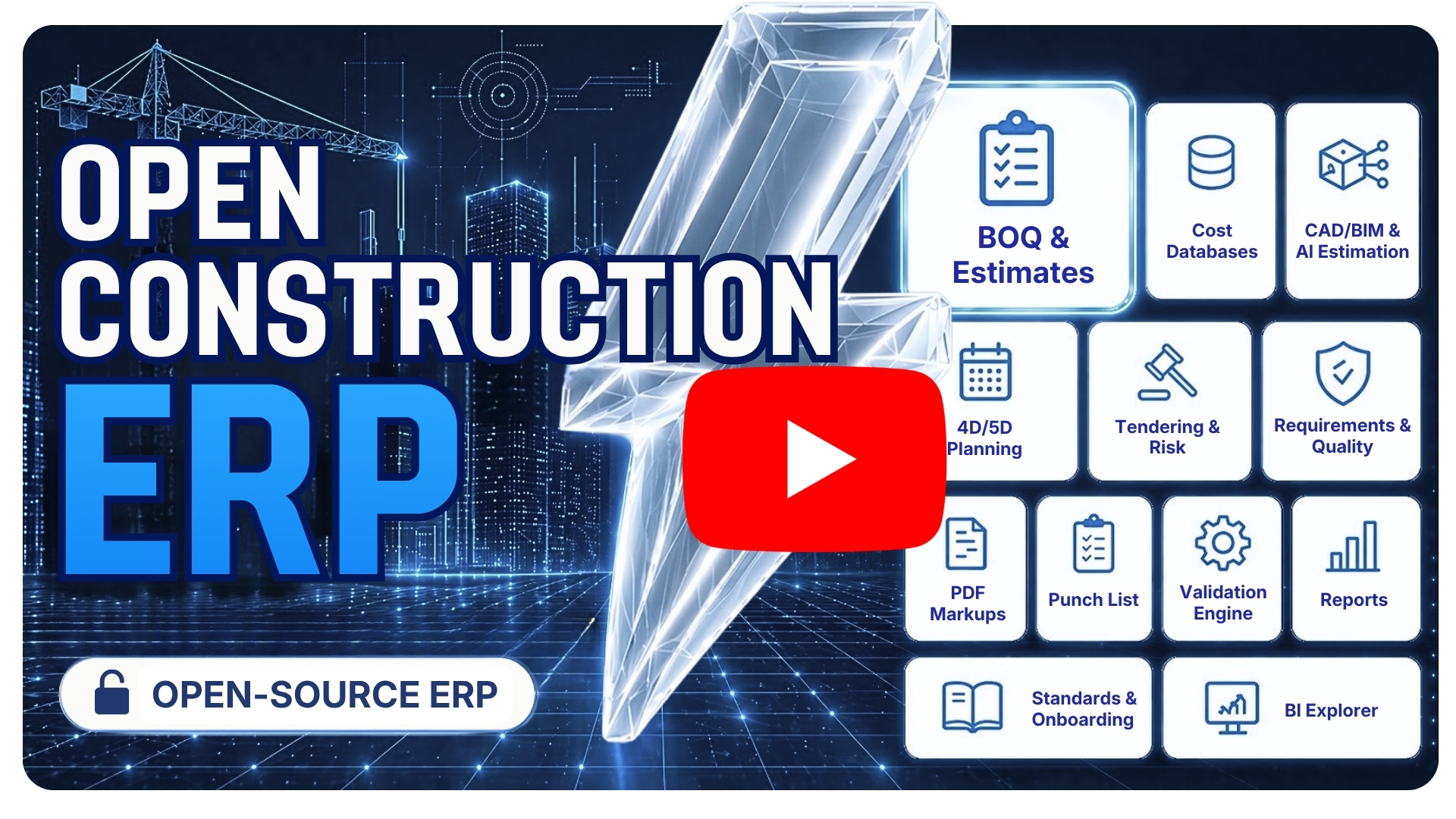
The 16 areas of the platform
The left navigation of the platform groups every module under one of 16 functional areas. Estimators, BIM coordinators, project managers and site supervisors each operate from their own subset - but all data sits in the same database, so handoffs are not exports.
Every module above is open-source and self-hostable. The full code, issue tracker and release notes are public.
How a real project flows through the platform
One database, not five different exports
In a classical mid-size construction-firm setup, each phase of a project runs in a different piece of software: a BIM authoring tool for the model, a separate estimating package for the BoQ, a separate scheduling tool, and a separate accounting system for the billing. Every handover between phases is an export-import; every change has to be pulled through every system by hand. The work between tools is its own line item in the project budget.
OpenConstructionERP runs those phases on one database. The IFC model imported from a BIM authoring tool, the BoQ assembled on top of it, the schedule that drives material orders, the variation that updates the contract value - all sit in the same PostgreSQL instance, all the way through to the final invoice. A model update is applied on next import to the dependent quantities, estimates and tender packages automatically. There remains one source of truth - and it does not sit with a software vendor, but inside the company.
For a typical project - say, a €5 Mio office building - the sequence looks like this: import the IFC and native BIM models, run automatic quantity take-off from geometry, apply the firm's own CWICR-anchored rates to the BoQ, drive the 4D / 5D schedule from the BoQ structure, generate GAEB X83 tender packages for subcontractors, compare bids, award contracts, run site billing and variations against the same contract object. Five tools collapse into five views of the same data.
Feature 01 - Estimating
Bill of Quantities - with live cost data and an AI second opinion
The BoQ editor sits at the heart of the platform. It runs on AG Grid, so even five-figure-row tenders stay responsive; it pulls live unit prices from the CWICR database, and a built-in AI cost advisor proposes rates in regions where you don't have historic data yet - but every figure waits for your approval before it lands in the tender.
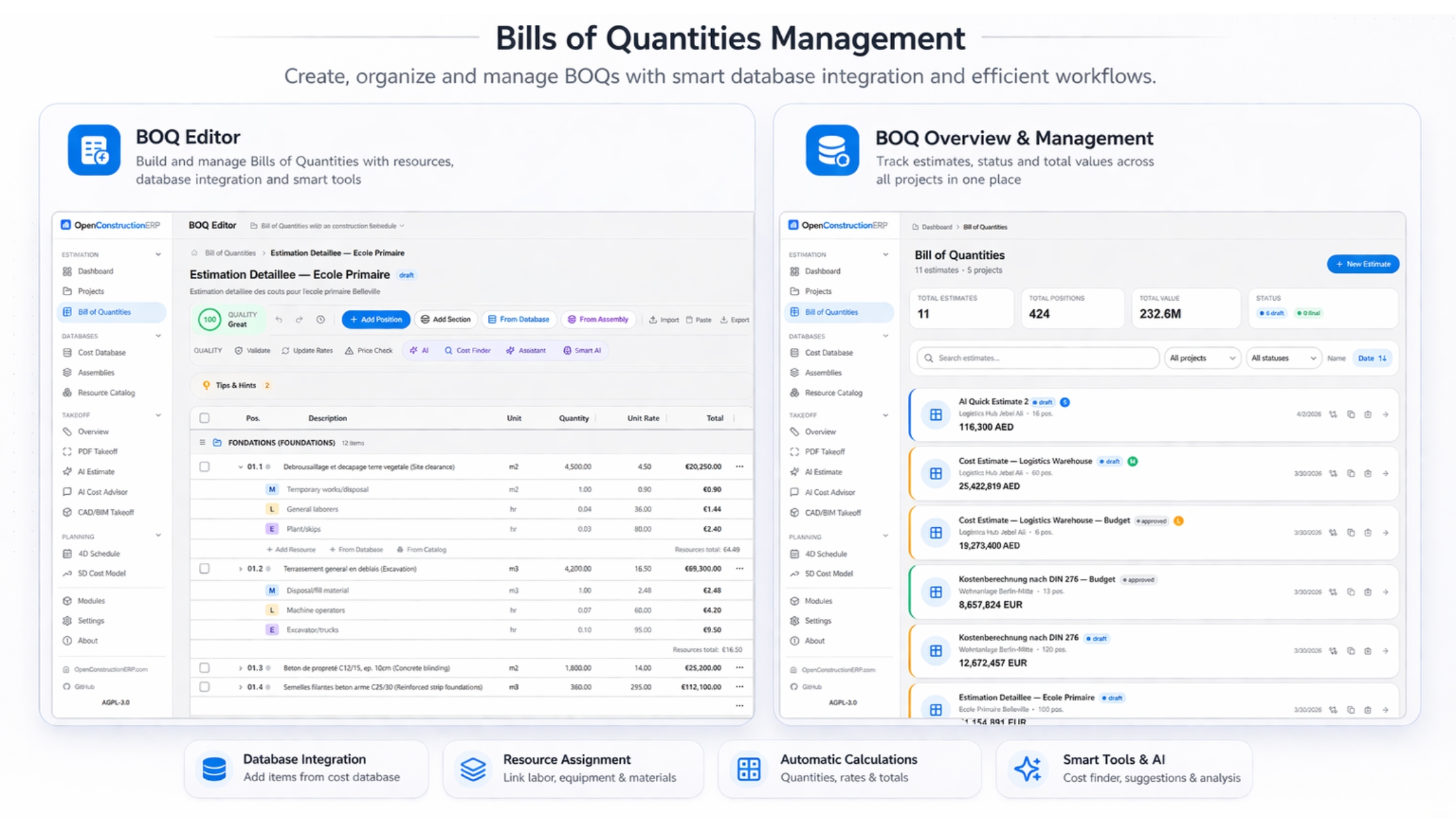
- Live CWICR lookup - type a description, get matching catalog items with regional prices in milliseconds.
- AI cost advisor - proposes unit rates with reasoning; never auto-applies, always requires human review.
- GAEB DA XML in/out (X83 / X84 / X89) - direct exchange with German-speaking public-sector tenders.
- Element traceability - every line item links back to its origin: BIM element, PDF take-off, or manual entry.
Feature 02 - BIM / CAD Take-off
From the model straight into the tender - no manual transcription
Most construction firms lose hours not to producing data, but to moving it between tools. OpenConstructionERP's CAD/BIM take-off matches elements from RVT, IFC, DWG and DGN directly to BoQ positions, proposes mappings via the AI layer, and keeps the trace from element to line item.
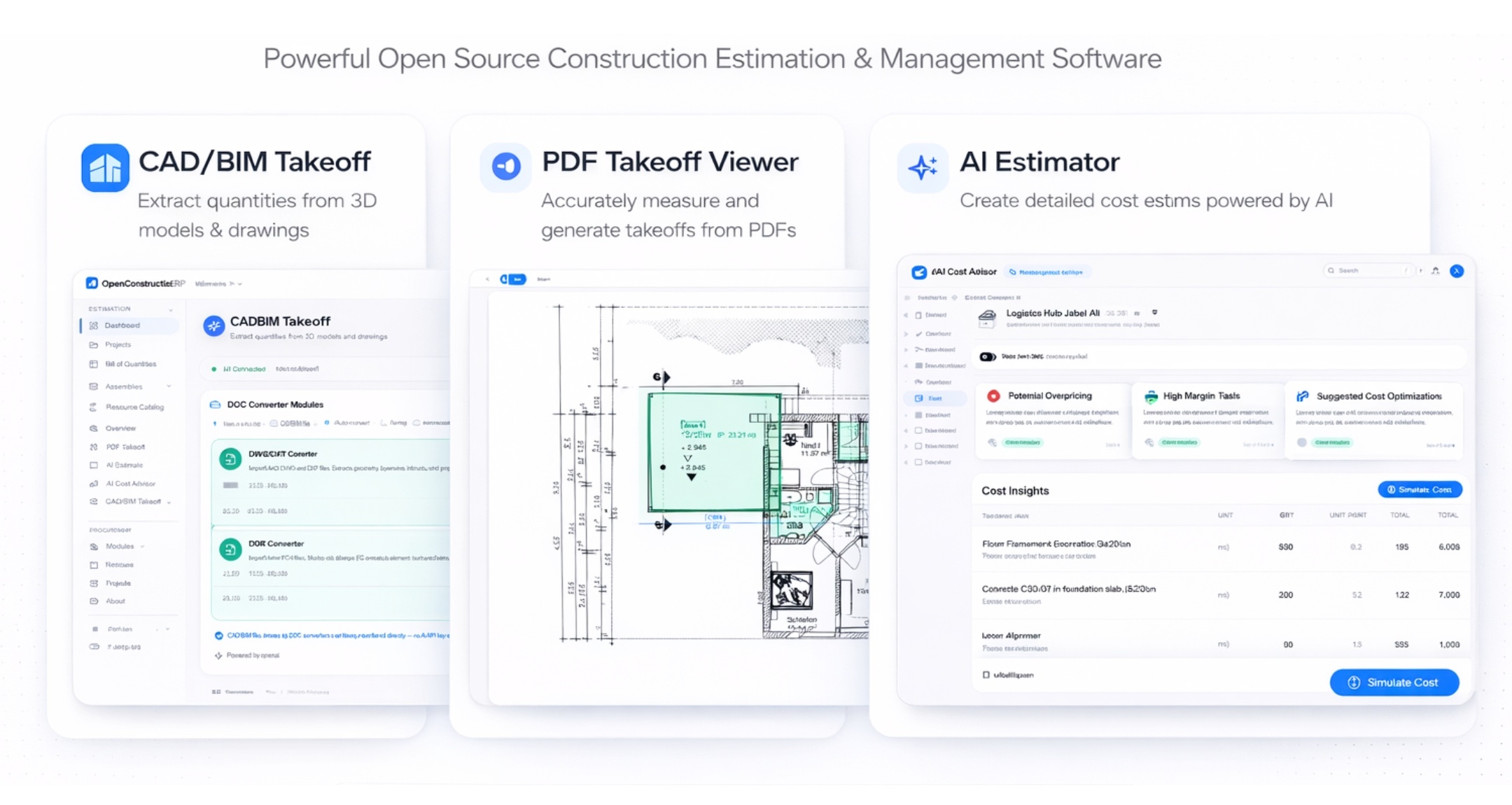
- Multi-format -
.rvt, IFC 2x3/4, DWG, DGN, all via open converters built in-house (cad2data). - AI-assisted matching - model elements suggested-mapped to BoQ items; you review and confirm.
- Round-trip updates - when the model changes, dependent quantities and prices update on next import.
- Open data model - exports back to XLSX, JSON, or a federated database for downstream BI tools.
Feature 03 - Cost Database
CWICR - 55,000+ items across 11 regional price baselines
CWICR is the cost-data backbone of the platform. Pre-loaded with catalog items in nine languages and eleven regional pricing systems, it can be extended with your own firm-specific positions, and every search is indexable - both as full-text and as vector embeddings, so a take-off search finds matching positions even when the wording differs.
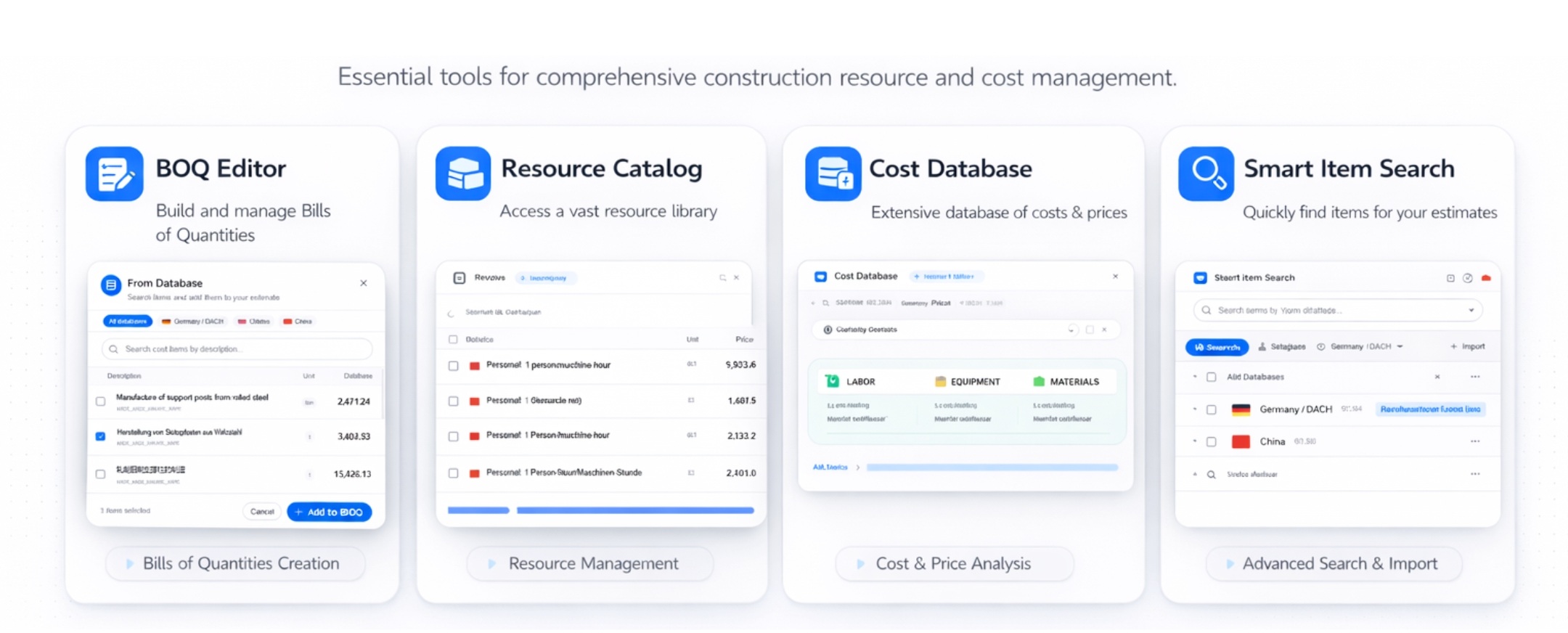
- 11 regions - DACH (DIN 276 / ÖNORM / SIA), UK (NRM), US (MasterFormat), France (DPGF), and more.
- 9 catalog languages - descriptions auto-translated where the regional standard allows.
- Vector search - semantic matching across positions even when wording diverges (powered by LanceDB / Qdrant).
- Customer extensions - add your own catalog branches without forking the database.
What the platform replaces, what it complements, what it doesn't cover
An honest inventory matters more here than a sweeping promise. OpenConstructionERP replaces one set of today's typical tools, complements another, and is simply not in scope for a third. A stack combination that works in practice for a mid-size European construction firm: a BIM authoring tool for modelling, OpenConstructionERP for estimating / tendering / site billing, a dedicated financial-accounting system, optionally a dedicated payroll system. The interfaces between these are well-established - IFC export from the BIM tool, GAEB XML for tendering, the standard accounting-XML formats for booking.
- Replaced - proprietary estimating & tendering systems: BoQ editor, estimating, tendering, on-site measurement, final invoicing.
- Replaced - proprietary 4D/5D modules: 4D schedule and 5D cost model with EVM, SPI/CPI, S-curve.
- Replaced - proprietary BIM quantity-take-off tools: element matching from RVT/IFC files, with AI suggestion and manual approval.
- Complemented - BIM authoring tools: modelling stays in those tools. OpenConstructionERP reads the resulting IFC / native files.
- Complemented - financial-accounting systems: via documented interfaces. Own bookkeeping covers construction billing only, not full P&L or balance sheet.
- Complemented - CAD authoring tools: the
cad2datapipeline reads DWG/DGN; it does not produce them. - Not covered - HR, payroll, time tracking: out of scope. Interfaces to existing systems are possible.
What adoption actually costs
Licence cost drops to zero. The real cost line items are honest.
Licence cost is the first question asked in a construction firm. Here is the honest answer, including the items where cost does arise.
Across the leading proprietary platforms in the European construction software market, the annual maintenance fee - according to independent user-review averages - typically sits around 20-25% of purchase price. On a typical 10-seat acquisition of around €200,000, that translates into an additional roughly €40,000-50,000 per year, for maintenance alone - no new modules, no training. External project-based rental licences - for instance those mandated for external design offices on large public works - typically run to €15,000-25,000 per year for three full-time users, and end the moment the project ends.
The question is not whether OpenConstructionERP is cheaper. The question is how the money is deployed: once into your own infrastructure and know-how, or perpetually as rental fees to an external vendor.
Concrete cost lines, with no marketing fog:
- Software licence - €0 (AGPL-3.0). Full functionality, no restrictions, no user limit, perpetual.
- Commercial licence - on request. For firms that cannot accept AGPL obligations (e.g. embedded SaaS use).
- Server / infrastructure - from ~€10 / month. A 2 GB VPS is enough for the core. Own servers possible; no cloud requirement.
- Initial setup - self-service or 1-2 days. Docker quickstart in ~5 minutes locally; guided setup via DDC or a partner institute is optional.
- Training & workshops - €3,500 / day (net), optional. Typical scope for a mid-size firm: 2-3 days initial training plus follow-up.
- Maintenance - no recurring fee. Updates via GitHub releases (every 2-3 weeks); maintenance contracts optional via the institute or DDC.
Architecture & data sovereignty
Where the data sits, and who can read it
This section is written for IT leads. It describes how OpenConstructionERP is operated and which data flows can be expected.
Deployment. The platform runs as a self-hosted web application. Three deployment variants are common: on-premise on your own server, private cloud at a European provider (Hetzner, IONOS, OVHcloud), or hybrid. The minimum hardware for the core is 2 GB RAM and 20 GB storage - a footprint every VPS provider supplies for under €10 per month. For project portfolios with more than 50 active projects in parallel, a slightly larger configuration is recommended.
Technical stack. Backend: Python 3.12 with FastAPI. Frontend: React 18 with TypeScript. Database: PostgreSQL 16 (SQLite also supported for development). Vector search for the cost database: LanceDB or Qdrant. All of these are standard open-source components and can be operated in any data centre. No dependency on proprietary cloud services. AI functions are vendor-agnostic via REST connectors to Anthropic, OpenAI, Gemini, Mistral, Groq, DeepSeek and further LLM providers - including self-hosted via Ollama or vLLM.
Data export & sovereignty. All data is fully exportable at any time: GAEB XML (X83, X84, X89) for construction tendering, Excel and CSV for standard reporting, JSON via the documented REST API, PostgreSQL dump for full database transfer. The data model is documented in source code and versionable.
Security & code audit. The entire source code lives publicly on GitHub under AGPL-3.0. A security review - by your own IT team or an external auditor - is possible at any time. The platform implements RBAC (role-based access control) and Single Sign-On via the standard protocols (OIDC, SAML). Updates are published every 2-3 weeks as versioned GitHub releases; each release ships with a documented changelog and reversible migrations.
Why this approach, why now
Three developments make this the right moment for an open construction ERP.
BIM has become a precondition for public-sector tenders, not a recommendation. With the Masterplan BIM für Bundesbauten (BMI, September 2021), Building Information Modeling has been made mandatory for German federal building construction in stages: Level I from late 2022 for all newly planned federal building projects (needs planning, design phase, commissioning); Level II from 2023 for projects above €50 Mio; since 2025, Level II also applies to all federal buildings above €500,000 construction volume. In federal infrastructure (road, bridge, rail) BIM has been mandatory since late 2020. For contractors on federal public construction, BIM is no longer optional - it is a precondition for participating in tenders. OpenConstructionERP supports IFC 4 and IDS (openBIM), BCF, OpenCDE as well as the common native formats RVT, DWG, DGN out of the box.
The proprietary vendor landscape is consolidating. Publicly available industry analyses indicate that a single large proprietary platform covers an estimated ~80% of construction projects above €1 Mio budget and ~90% of public-sector administrations in the DACH region. Several large proprietary vendors have been steadily acquiring smaller players over the past years. Licence costs are rising faster than construction prices; the cost of switching from one stack to another is high. This market structure produces a growing demand for alternatives that do not sit inside the same consolidation logic.
An institutional gap has just opened. The German federal programme Mittelstand-Digital Zentrum Bau (2022-2025, €5 Mio funding) ended in October 2025 after reaching around 1,500 people in the construction and real-estate industry. With its closure, an institutional gap opens up in the practical dissemination of open BIM and data standards to mid-size firms. OpenConstructionERP is actively in contact with universities and industry associations that want to fill this gap.
Who already works with our open tools
Over the past decade DataDrivenConstruction - the team behind OpenConstructionERP - has worked with 24 construction, engineering and infrastructure organisations across four continents on workshops, pilot pipelines, custom development and data consulting:
What DataDrivenConstruction delivers - beyond the ERP
Your path in the data-driven construction industry
Adopting open construction tools is not a one-step migration - it is a journey across five phases, from the fundamentals of construction data through automation, advanced analytics and full ERP integration. DDC's workshop programme is built around exactly this roadmap, with every workshop using your own project data, not synthetic examples.

Frequently asked questions
- Is the core really free and open source? Yes. The core is AGPL-3.0 on GitHub. You can self-host permanently, review every line, fork or run it in production. For firms that cannot use AGPL, a commercial licence is available.
- Does the platform work without an internet connection? Yes. AI features are optional; the core functions (BoQ editor, take-off, estimating, tendering) run fully offline.
- What maintenance should a firm plan for? Updates via GitHub releases every 2-3 weeks, migrations reversible. Self-maintenance is feasible for any team with one DevOps-capable engineer; optional maintenance contracts exist.
- Can data be migrated from existing proprietary estimating systems? Via GAEB XML in most cases without extra effort. Specialised migration paths are in the pilot-project set-up.
Four ways a first contact can unfold
Four paths, from the lowest commitment to a deeper engagement. Each step stands on its own - combinations are possible but not required.
-
Run it yourself
Install locally - two commands, Python or Docker, done in 5 minutes. The bundled demo data lets you walk through the full functionality without further preparation. Repository & instructions:
github.com/datadrivenconstruction/OpenConstructionERP - Guided demo call A guided walk-through of the platform with focus on your firm's actual workflows. Typical length: 60-90 minutes, online or on site. Arranged directly or via a partner institute.
- Workshop A two-day hands-on workshop with your firm's actual project data. Covered: data extraction from existing BIM models, building a custom cost database, integration with your existing tools. Fee €3,500 / day (net).
- Pilot project Guided implementation on a real construction project at your firm, with a partner institute providing the domain support. Scope and milestones agreed together. Suitable for firms that, after the demo, are convinced and want to test productive use.
Trademark notice. All product names, file-format extensions (e.g. .rvt, .ifc, .dwg, .dgn), open-standard identifiers (GAEB, DIN 276, NRM, MasterFormat, ÖNORM, SIA, IFC, BCF, OpenCDE, IDS) and company names referenced in this article are the property of their respective owners. Their use here is descriptive and refers to interoperability or industry context only. No affiliation, endorsement, sponsorship or partnership with OpenConstructionERP or DataDrivenConstruction is implied unless explicitly stated.