From expert opinion to numbers anyone can verify.
For most of its history, construction has run on expert judgment. Budgets, schedules and costs are set by experienced people, and they are trusted because of who produced them - not because anyone can check the numbers underneath. This talk, given at the Future/s of Construction 2026 conference at ETH Zürich, makes one simple argument: that is about to change.
As project data becomes open and machine-readable, estimating a building's cost and time stops being a closed, specialist craft - and starts becoming something a client can do too. The talk explains, in everyday language, what is shifting in the industry right now: where the data already lives, how to get it out without heavy software, and why AI has quietly moved estimating within reach of anyone who can describe what they want.
Watch the talk
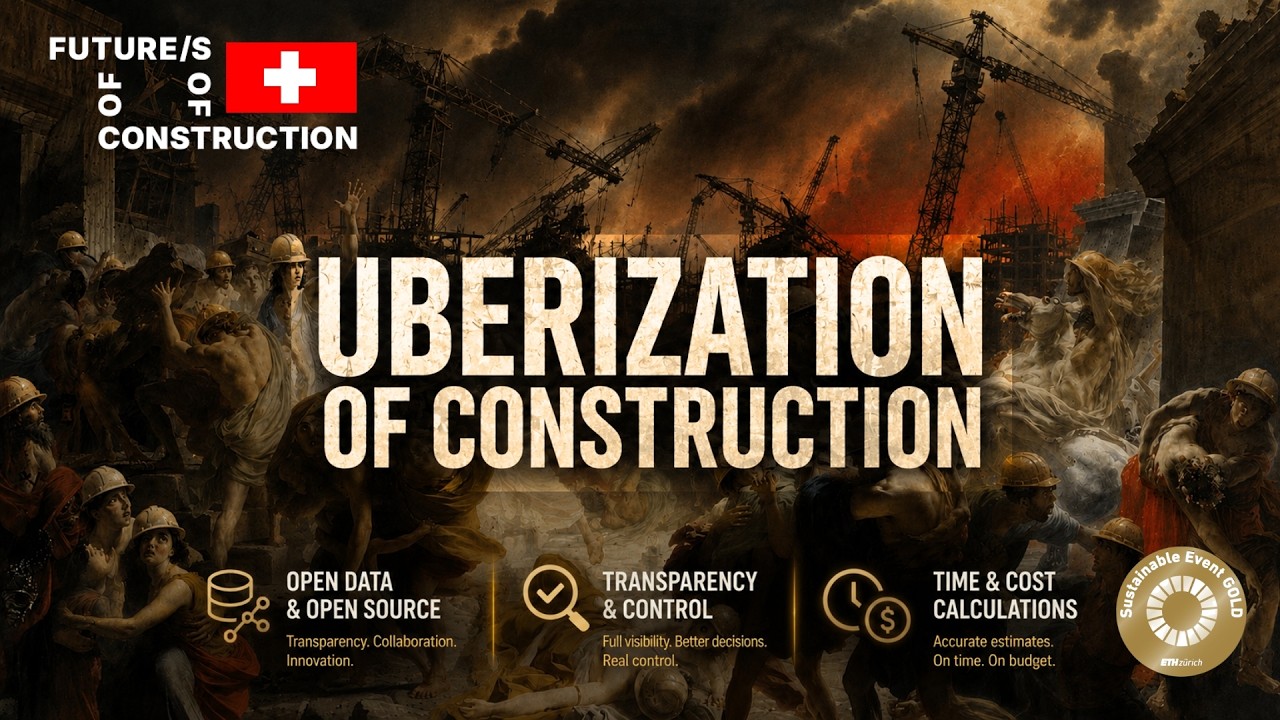
What the talk covers
A project's most important figures - the budget, the schedule, the final cost - still rest on individual expertise. When the basis is a spreadsheet nobody else can open, or a judgment call, every decision downstream inherits that uncertainty. The alternative is already here: estimates that trace back to the model and the data they came from, so anyone can check them.
The geometry and quantities you need are already inside the design files. You do not need a wall of specialist buttons to reach them. The same Revit, IFC and DWG files can be converted straight into databases and ordinary spreadsheets that any estimator can read - no expensive modelling suite required just to count what is in the model.
The largest software vendors have been reading CAD and BIM files as databases for three decades. That capability was never a secret - it simply stayed locked inside proprietary tools, and the wider market never noticed. Open converters now put the same approach in everyone's hands.
Today's AI assistants - ChatGPT, Claude and others - can take a request written in ordinary words ("how much concrete is in this model, and what would it cost?") and return quantities and a priced estimate, working directly on the project data. The skill shifts from operating software to asking the right question.
When project data is open and the tools to read it are free, the contractor is no longer the only party who can put a number on a building. Clients, owners and public bodies can run their own estimates - and check the ones they are given. That is the "Uberization" in the title: not cheaper labour, but a market where verifiable cost and time are available to everyone, instead of being gatekept by whoever owns the software.
From the idea to working software
OpenConstructionERP is this argument turned into a working, open-source platform. Open converters read .rvt, .ifc and .dwg files into structured data; an open cost database prices the quantities; and an AI layer proposes estimates in plain language - all self-hosted, under AGPL-3.0, with the data on your own infrastructure. The live demo runs the full flow from model import to a priced bill of quantities.
Trademark notice. All product and company names, file-format extensions (e.g. .rvt, .ifc, .dwg) and AI assistant names referenced in this article are the property of their respective owners. Their use here is descriptive and refers to interoperability or industry context only. No affiliation, endorsement or sponsorship is implied unless explicitly stated.