The idea behind this project has not changed: give construction teams one clear, simple, useful platform they can run themselves, with their data staying theirs. What changed between 7.0.0 and 10.9.0 is how much of the real work it now covers. You can bring in a drawing or a model, measure quantities from it, turn those quantities into a resource-based estimate, plan and cost the programme, control quality and change on site, and track carbon alongside cost, without leaving the platform and without sending your project to anyone else's cloud.
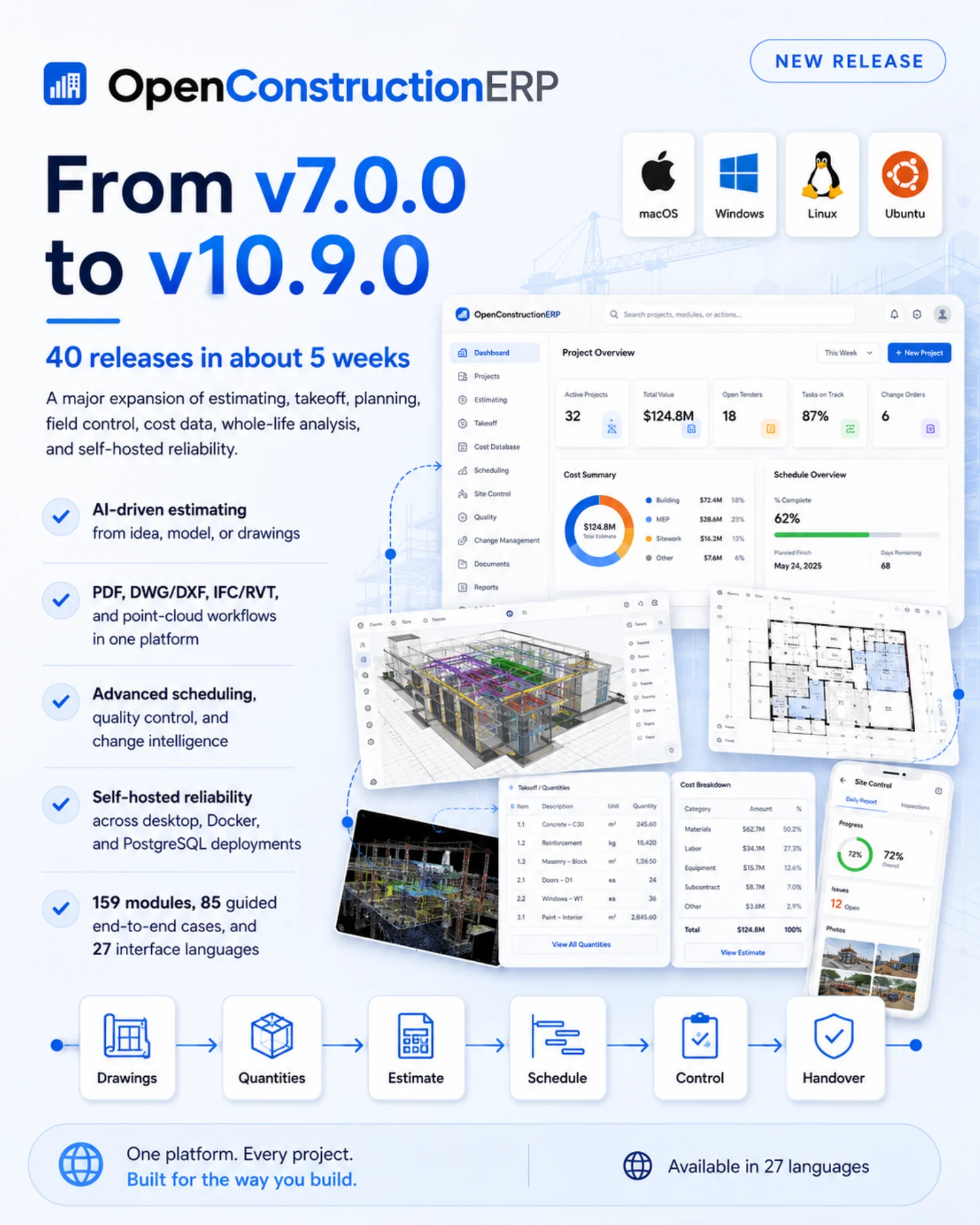
What changed from v7.0.0 to v10.9.0
- AI-assisted estimating, from concept to detail. Start with a fast conceptual or rough-order-of-magnitude figure when all you have is an area and a use, then move to a detailed resource-based estimate as the design firms up. The platform suggests classifications and rates from its own cost data, shows a confidence you can see, and leaves the final call to you.
- Quantity takeoff from the formats you already have. Measure straight off vector DWG and DXF, measure and scale on PDF drawings, and count repeated symbols by example so a door or a fitting is tallied once and found everywhere. Measured quantities flow into the bill of quantities instead of being retyped.
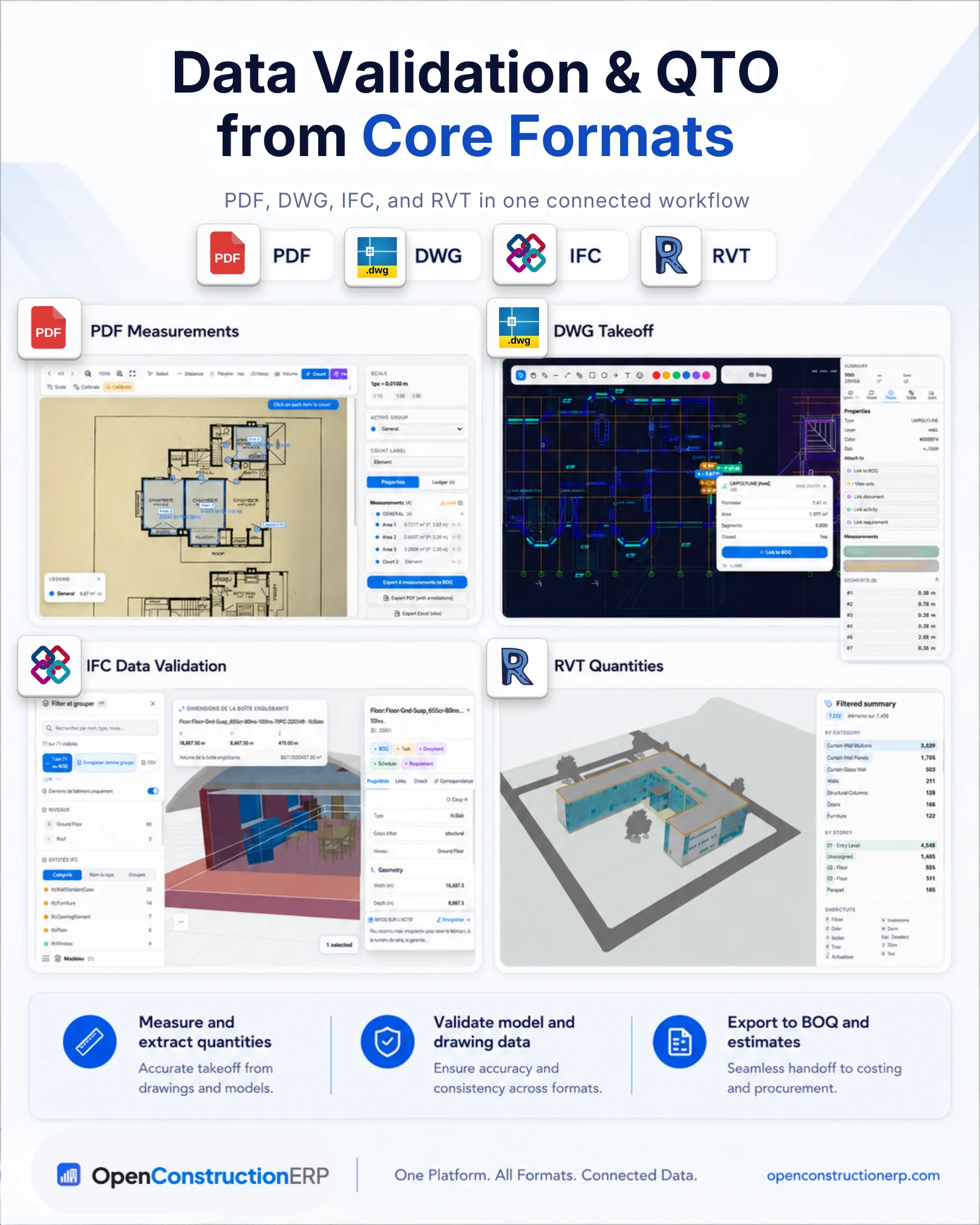
- Validation and quantities from core formats. PDF, DWG, IFC and RVT are converted to one canonical format and checked before they become numbers, so structure, completeness and classification are caught early rather than in the estimate.
- Federated BIM. Combine several models into one coordinated view, filter and inspect elements, and drive quantities and site issues straight from the model, all without a proprietary BIM engine.
- Advanced scheduling, with cost and time linked. A full scheduling engine ties the programme to the estimate and the model, with earned value and cost-value reconciliation so progress, cost and time are read from the same source rather than three spreadsheets.
- Quality and change control. Inspections, checklists, punch lists, requests for information and submittals, plus a change workflow that prices a variation and carries it through to the forecast, so quality and change are tracked where the estimate lives.
- Site delivery, captured where it happens. Site logistics, commissioning, prefabrication, field time and daywork are recorded on site, so what actually happened feeds the forecast rather than being reconstructed later.
- Whole-life carbon alongside cost. Embodied and operational carbon sit next to the numbers you already have, so a material or design choice can be weighed on carbon and on cost at the same time.
- Yours to run. Open source under AGPL-3.0, runs on a small 2GB server, works in 27 languages out of the box, and keeps every project on your own stack. No signup, no lock-in, everything exportable.
Validation and quantities from the formats you already have
Most projects do not arrive as a clean model. They arrive as a PDF, a DWG, an IFC or an RVT, in whatever state the last person left them. OpenConstructionERP converts all of them to one canonical format and runs them through validation before anyone measures anything, so gaps in structure, completeness or classification show up as a traffic-light report rather than as a wrong number three steps later. From the same converted files you measure quantities, and those quantities become the starting point for the estimate.
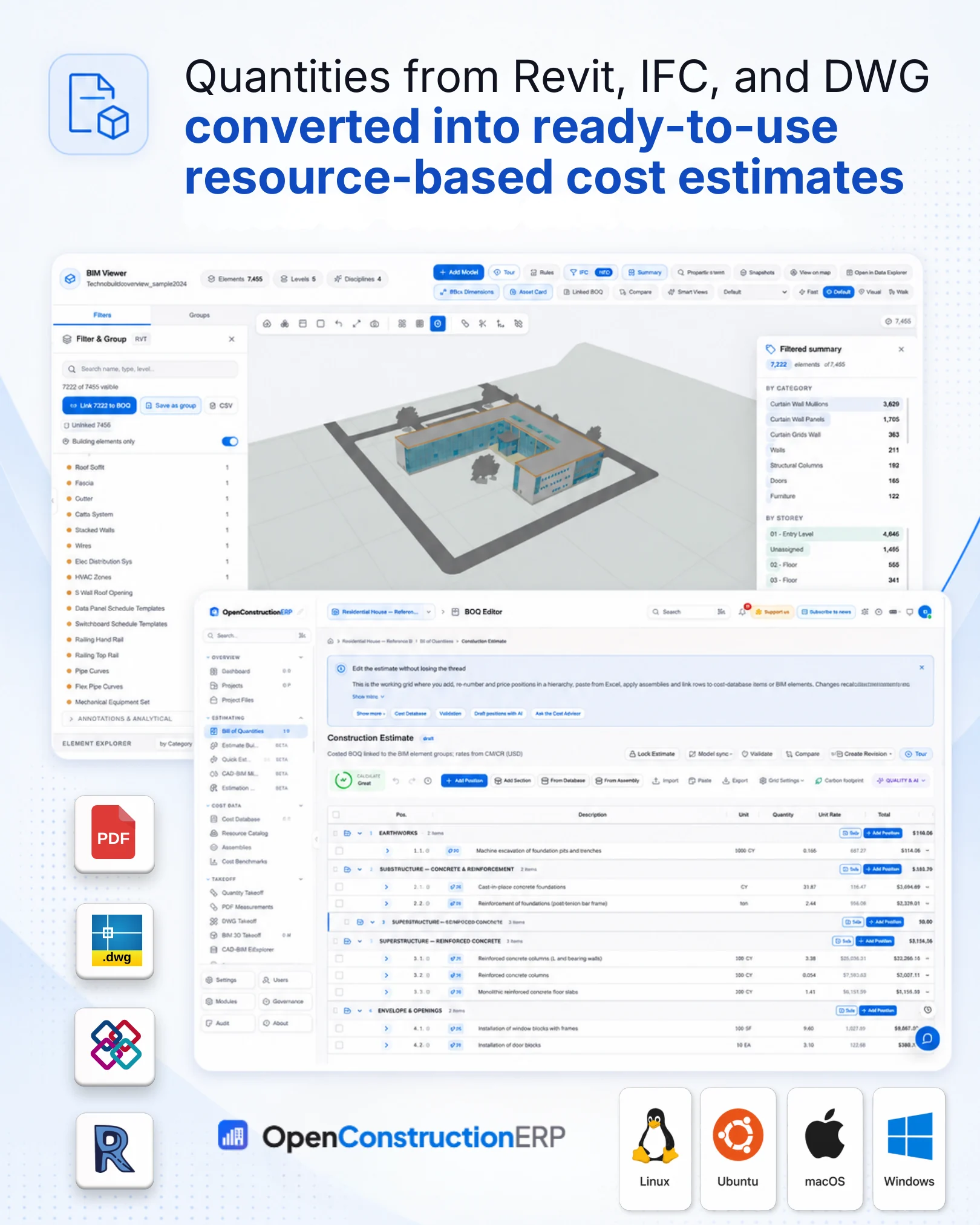
From quantities to a resource-based estimate
Quantities on their own are not an estimate. The bill-of-quantities editor turns them into a priced, resource-based estimate: labour, material and plant built up per position, assemblies for the recipes you use again and again, and live totals that roll up as you work. The cost data behind it spans many regions and reads in 27 languages, so the same estimate can be priced for where the work actually is. Every suggestion the platform makes carries a confidence and stays a suggestion until you accept it.
One platform for the whole project
The reason all of this lives in one place is simple: an estimate, a programme, a model and a site report that share one source stop disagreeing with each other. Between 7.0.0 and 10.9.0 the module count grew from 117 to 159, and the set now reaches across the whole lifecycle, from early cost planning through BIM, procurement, scheduling, quality, change and site delivery to reporting and handover.
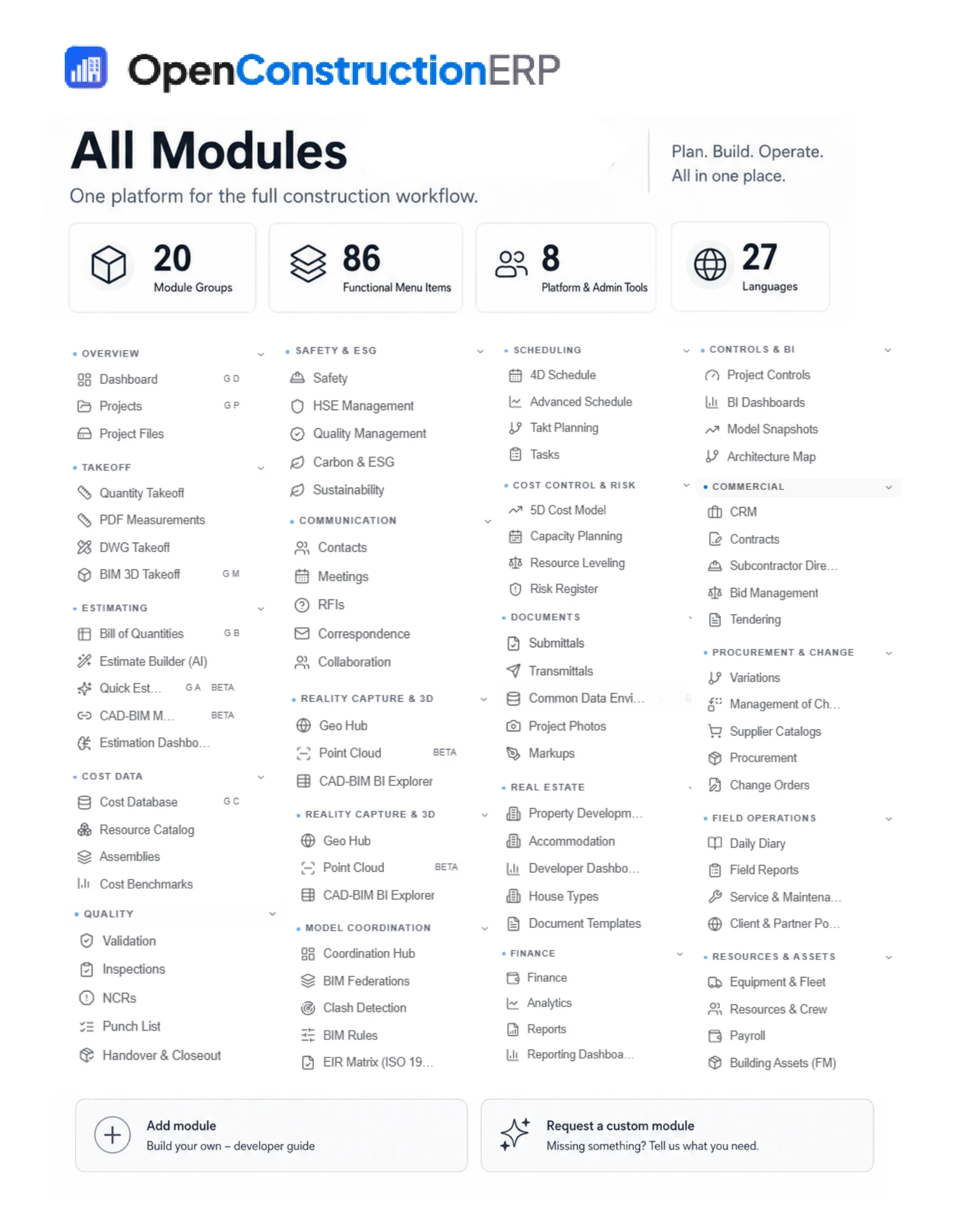
159
modules across the lifecycle, up from 117 at version 7.0.0.
85
guided worked cases that walk through real construction tasks step by step.
27
languages built in, so the platform and its cost data read in the user's own language.
Alongside the headline additions, more than 150 community reports have been worked through since 7.0.0, from takeoff and BIM fixes to money and currency correctness across the bill of quantities. Thank you to everyone who filed one; the reports are read carefully and the fixes are written from scratch.
Run the whole project on your own stack
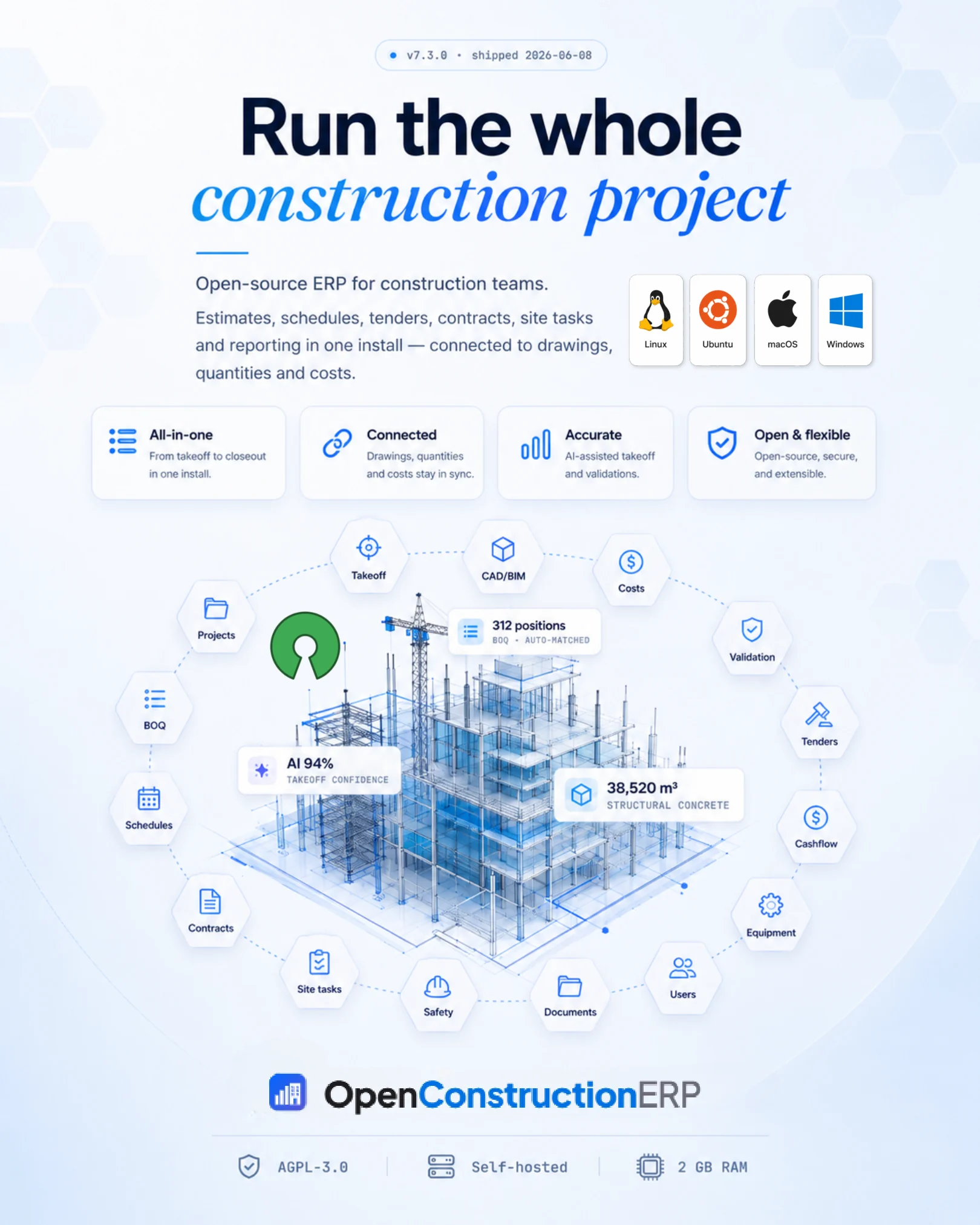
OpenConstructionERP installs with a single command and runs on a small server. Desktop builds for Windows, macOS and Linux carry the same one-installer setup, and the Linux build ships the CAD and BIM converters for DWG, RVT and IFC. It is open source under AGPL-3.0, self-hosted, and light enough for a 2GB machine.
Install or upgrade
pip install --upgrade openconstructionerp
You can grab the latest desktop installers from
openconstructionerp.com/download.
If you run an external PostgreSQL through DATABASE_URL, nothing
about that connection changes. Questions or trouble upgrading, write to
info@datadrivenconstruction.io.
Try v10.9.0 today.
Live demo in your browser, or self-host in five minutes. AGPL-3.0, no signup required.